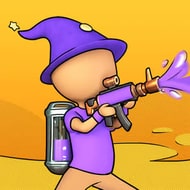
What happens when your paint gun runs dry in the middle of a turf war and the floor around you is still the wrong color? In Paint Strike that moment separates players who understand the win condition from players still treating it like a straightforward shooter. You’re reshaping the arena itself, one wall and floor tile at a time, and a dry tank at the wrong second can cost your team the whole map.
| Genre |
Arcade Shooter |
| Platform |
Browser |
| Players |
Team-based multiplayer |
| Core Objective |
Cover the most terrain in your team’s paint color |
| Controls |
Keyboard and mouse or touch |
Coverage Over Kills: The Real Objective in Paint Strike
The first thing that trips up new players is assuming Paint Strike scores like a typical shooter, where the team with the most eliminations wins. It doesn’t. Splatting an opponent only removes them from the field for a short window, and the match is decided by how much of the arena’s walls, floors, and obstacles end up covered in your team’s color when time runs out.
That distinction changes almost every decision you make. Chasing a fleeing opponent into a corner your team hasn’t painted yet can look aggressive, but it often costs more coverage than it’s worth, and players who treat every encounter as a shootout tend to finish matches confused about why their team lost despite a favorable splat count.
Paint Rifles, Rollers, and Brushes in Paint Strike
Weapon choice in Paint Strike shapes how you contribute to the coverage total. Paint Rifles handle precise, long-range shots and are the tool most players reach for to splat someone across an open courtyard. Rollers and Brushes trade range for raw coverage speed, dragging a wide swath of your team’s color across floors and low walls in a single pass.
- Paint Rifles for accurate, long-range splatting
- Rollers for fast, wide-area floor coverage
- Brushes for tight corners and vertical surfaces
Scoreboard-climbing players tend to switch weapons mid-match the moment their team needs coverage instead of another splat.
Splatting Opponents and the Temporary Timeout
Getting hit by enough opposing paint in Paint Strike doesn’t end your match, it benches you for a short timeout before you respawn. That temporary removal is enough to swing control of a chokepoint or let the other team finish painting a contested room, which is why some players argue splatting should carry a longer penalty while others insist the short timeout is exactly what keeps matches from turning into one-sided blowouts.
Getting splatted right as your team pushes into enemy territory is one of the more frustrating swings the game can throw at you, and it’s a frequent complaint in community discussions about balance.
Paint Bombs, Drones, and Sticky Splatter
Beyond the standard weapons, Paint Strike gives you tools for controlling space rather than just covering it. Paint bombs blanket an area on impact, useful for claiming a room before opponents arrive. Drones scout or paint from angles you can’t reach directly, and sticky splatter clings to surfaces and slows anyone who walks through it.
- Throw a paint bomb into an uncontested room to claim it fast
- Send a drone ahead to cover elevated surfaces
- Lay sticky splatter across a chokepoint the enemy team keeps pushing through
Area-control specialists lean on these tools instead of a weapon, and that role is just as valuable to a match as someone racking up splats.
Team Battles and Capture the Flag in Paint Strike
The standard team battle mode is where most matches happen, decided purely on final coverage percentage once the timer ends. Capture the flag layers an objective on top of that same painting foundation, forcing your team to balance holding territory with pushing toward the flag, which rewards squads that coordinate roles instead of everyone grabbing a Paint Rifle and running for the center of the map.
Does splatting an opponent remove their team’s existing paint?
No, splatting only sidelines the player temporarily. Paint that team already put down stays until someone covers it with a different color.
Why does my team lose despite getting more splats?
Because the match is scored on terrain coverage, not eliminations. A team that splats fewer opponents but paints more floor space consistently beats a team focused purely on picking fights.
What’s the fastest way to cover ground early in a match?
Rollers and Brushes cover far more area per second than Paint Rifles, so switching to one during the opening rush usually secures more territory than fighting for kills first.
Between the coverage math, the weapon swapping, and the sticky splatter traps that ruin a well-timed push, Paint Strike ends up being less about who shoots straighter and more about who reads the map’s changing colors faster.