What happens when your grappling hook line goes taut a fraction of a second too late? In Idols of Ash, that split-second miss is usually the difference between a clean swing across a chasm and a long fall back into the ash, and sometimes it’s the difference between staying quiet and drawing the attention of something that hunts by sound. There’s no sword here, no health bar to manage through combat, just momentum, height, and the constant awareness that you are being listened for.
| Genre |
First-person parkour horror |
| Core Mechanic |
Grappling hook traversal and momentum swinging |
| Main Threat |
The Murderpede |
| Combat |
None — descent and survival only |
| Average Run Length |
20 to 40 minutes on normal difficulty |
Grappling Hook Momentum in Idols of Ash
The entire traversal system in Idols of Ash is built around one tool: a grappling hook that lets you latch onto distant surfaces, launch forward, and carry that momentum into the next gap before gravity catches up with you. Fire it too early and you waste the swing arc; fire it too late and you’ve already started falling with nothing to grab onto. Chaining several swings in a row without touching solid ground is the closest thing the game has to a skill expression, and players who master the timing describe the feeling as closer to a rhythm exercise than a platformer.
Momentum carries between swings, which means a clean launch off one ledge can set up a much longer jump than the raw distance would suggest. This rewards players who plan two or three moves ahead instead of treating each gap as an isolated puzzle. Early in the game the gaps are forgiving enough to let you learn the arc of the swing without serious consequence.
By the time you reach the lower sections of the structure, the margins shrink considerably. Ledges are narrower, the ash-covered surfaces are less predictable underfoot, and a mistimed swing can send you tumbling into a drop you won’t recover from. Momentum-chasing players thrive here, since they’ve already built the muscle memory the earlier sections were quietly teaching.
How the Murderpede Hunts by Sound
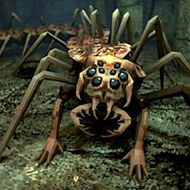
There is no health bar shared between you and the Murderpede, no stealth meter, and no combat option to fall back on if it finds you. Instead, the creature tracks the noise you generate: a hard landing, a scrape against a wall, a rushed sprint across loose debris. Moving carefully and controlling your landings is often more useful than moving fast, which runs against the instinct most parkour games train into you.
This inversion is a large part of what players discuss most. The temptation to chain swings as fast as possible is strong, but doing so recklessly tends to generate exactly the kind of noise that draws the Murderpede toward your position. Cautious players who slow down before a landing and choose quieter paths tend to survive longer stretches than aggressive players who prioritize speed above everything else.
Once the Murderpede’s presence becomes audible nearby, the tension shifts immediately. You’re no longer solving a traversal puzzle in isolation; you’re solving it while listening for a sound that tells you whether to keep moving or hold perfectly still. That layering of a physical skill challenge on top of an audio-based threat is the mechanic most people bring up when describing what makes Idols of Ash tense rather than simply difficult.
Why Idols of Ash Has No Combat System
The decision to strip out combat entirely changes how every encounter with the Murderpede plays out. You cannot fight back, you cannot stun it, and you cannot out-damage the threat the way you could in a conventional horror game. The only real response is distance, silence, or both.
This design choice is divisive among players. Some find the total absence of combat refreshing, arguing it keeps the focus entirely on movement and tension rather than diluting it with a fight mechanic that would undercut the horror. Others find it frustrating in the moment, especially the first time the Murderpede appears and instinct says to turn and fight rather than run.
Whichever camp you fall into, the lack of combat forces a specific kind of player behavior: constant forward planning. You can’t clear a path by force, so every swing and every landing has to account for where you’ll be exposed next.
Reading the Ash-Covered Structure’s Verticality
The structure you’re descending is enormous, layered, and built almost entirely around vertical movement rather than horizontal exploration. Ash coats most surfaces, which affects both visibility and the way certain ledges crumble or shift slightly under repeated weight. Judging distance across open ash-filled chasms takes longer to get comfortable with than judging distance in a more clearly lit environment.
Because the goal is descent rather than exploration, there’s rarely a reason to backtrack, and the game doesn’t really support it well if you try. Players who treat every level as a one-way trip tend to have an easier time mentally than players who keep looking for shortcuts back to previous sections.
A full descent from top to bottom typically lands somewhere between 20 and 40 minutes on normal difficulty, assuming a reasonably clean run without excessive backtracking or repeated deaths. That window shrinks considerably for players who have mapped out the swing patterns already, and stretches out for anyone still learning where the Murderpede tends to appear.
Environmental Hazards Beyond the Murderpede
Not every threat in Idols of Ash comes from the creature hunting you. The structure itself is falling apart in places, and several of the more memorable moments in the game come from environmental failure rather than direct pursuit.
- Ash-crusted ledges that give way after a second or two of standing weight, forcing an immediate swing before the ground disappears.
- Narrow gaps where a grapple point exists but the angle makes a clean swing genuinely difficult to land.
- Sections with limited visibility where judging the distance to the next anchor point relies more on memory than sight.
These hazards compound with the Murderpede’s presence rather than existing separately from it. A crumbling ledge forces noise at exactly the moment you’d rather stay silent, and that overlap is where most unplanned deaths happen.
Player Debates Around Checkpoint Placement
One of the more common criticisms leveled at Idols of Ash concerns checkpoint spacing. Because a full run takes up to 40 minutes, a death late in a section can mean repeating a meaningful chunk of traversal, and not every player agrees on whether that repetition adds tension or just adds frustration.
Speedrunning-minded players tend to view sparse checkpoints as part of the challenge, treating each section as a single continuous test of nerve. More casual players are more likely to bring up checkpoint spacing as the single biggest friction point in an otherwise tightly designed loop.
There’s no universally agreed answer here, and it’s worth going in expecting that a death might cost you real progress rather than a quick retry from just a few seconds back.
Can you fight back against the Murderpede in Idols of Ash?
No. There is no combat system of any kind built into the game. Your only tools against the Murderpede are silence, distance, and choosing quieter paths across the structure rather than confronting it directly.
How long does a full run of Idols of Ash usually take?
A single descent on normal difficulty generally takes between 20 and 40 minutes. The exact time depends on how efficiently you chain grappling hook swings and how many times the Murderpede forces you to change your route.
What actually attracts the Murderpede’s attention?
Noise is the main trigger. Hard landings, fast sprinting across debris, and clumsy grapple swings all generate sound that the Murderpede can track, which is why deliberate, controlled movement tends to work better than rushing.
Idols of Ash succeeds by trusting a single traversal tool and a single threat to carry an entire descent, and the result is tense in a way that has little to do with jump scares. Once you’ve felt the Murderpede’s presence close in after a careless landing, you understand why the grappling hook’s momentum matters as much as the creature itself, and why so many players talk about that 20 to 40 minute descent as one continuous held breath.