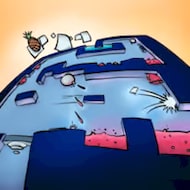
Momentum in Big Tower Tiny Square does not work the way other platformers train you to expect. There’s no sprint, no double jump, and nothing floaty about the landing, so the instinct to buffer a jump early or coast through a gap gets punished almost immediately by a spike strip placed specifically to catch that habit.
| Genre |
Precision rage-platformer |
| Core Mechanic |
Exact jump timing with no sprint or double jump |
| Avatar |
A minimalist tiny square |
| Goal |
Reach the stolen pineapple at the top of the tower |
| Structure |
One giant tower split into single-screen rooms |
Momentum and Wall-Slides in Big Tower Tiny Square
The square moves at a fixed pace with no acceleration curve to lean on, so every jump distance has to be judged by eye rather than built up through a running start. Wall-slides are the closest thing to an advanced technique here, letting you shave a fraction of height off a fall to line up a narrow landing between two lasers instead of overshooting into them.
Bounce pads complicate this further, overriding the normal jump arc and demanding a different read on timing than a standard hop. Players used to forgiving platformers tend to die repeatedly on the first bounce pad room because old habits from flat-ground sections no longer apply once footing stops being solid.
How the Tower’s Room-by-Room Structure Works
Rather than one continuous climb, Big Tower Tiny Square is broken into large single-screen rooms stacked on top of each other, each built around a specific hazard idea rather than a general difficulty curve. One room might be entirely about dodging a moving laser sweep, while the next tests timing against spinning blades over a lava pit with no room for error on the landing.
This structure is why the game leans on memorization so heavily. You’re not reacting to randomness, you’re learning a fixed sequence of threats and finding the one clean path through, closer to solving a puzzle than reacting on instinct once you’ve died to a room enough times to know its layout.
Early rooms near the base teach the core jump and wall-slide vocabulary, but by the upper sections, several hazard types combine into one short stretch, and a single room can easily take a dozen attempts.
Checkpoints and the Rage-Game Balance in Big Tower Tiny Square
What keeps Big Tower Tiny Square from becoming purely frustrating is a genuinely generous checkpoint system placed right before most harder sequences. Dying drops you back seconds from where you failed rather than sending you on a long trek through rooms already cleared, a deliberate softening of the rage-game formula the tower otherwise commits to fully.
That generosity is also debated. Some feel it takes the sting out of failure and makes the difficulty feel more like memorization than genuine skill testing, while others argue that without it the constant instant deaths from lasers and spikes would make the climb unplayable for anyone short of a precision-platformer veteran.
Lasers, Saws, and the Hazard Vocabulary
The tower’s hazard set stays fairly small: lasers that sweep on a timer, spinning saws on fixed arcs, lava pits that kill on contact, and the occasional bullet fired from a wall-mounted turret. The trick is that these get remixed constantly, so a laser pattern that was straightforward alone becomes a genuine problem once a saw spins through the same space.
Speedrun-focused players treat hazard patterns as fixed puzzles solved once and executed from muscle memory, chasing the fifteen-to-twenty-minute clears experienced players report. Casual climbers take a slower approach, often needing closer to an hour to reach the pineapple.
Questions Players Ask About Big Tower Tiny Square
- Why does the square die from things that barely seem to touch it? Hitboxes on hazards like lasers and saws sit tight around the visual edge, so a landing that looks close often still counts as contact.
- Is there any way to skip a hard room? No, every room sits directly in the climb’s critical path, so the pineapple can only be reached by clearing each section in order.
- Why do checkpoints sometimes feel placed right before another hazard? Checkpoints sit just ahead of the next challenge on purpose, so a death resets you into the attempt rather than making you retrace an already-solved room.
- Does the square ever get new abilities like a double jump? No, the moveset stays fixed for the whole climb, part of why later rooms rely on combining existing hazards rather than new controls.
By the time the pineapple comes into view at the top, Big Tower Tiny Square has usually turned a handful of simple mechanics, a fixed jump, a wall-slide, a well-timed bounce pad, into a climb that feels earned, one small square against a tower that never stops testing the same basic rules in new combinations.